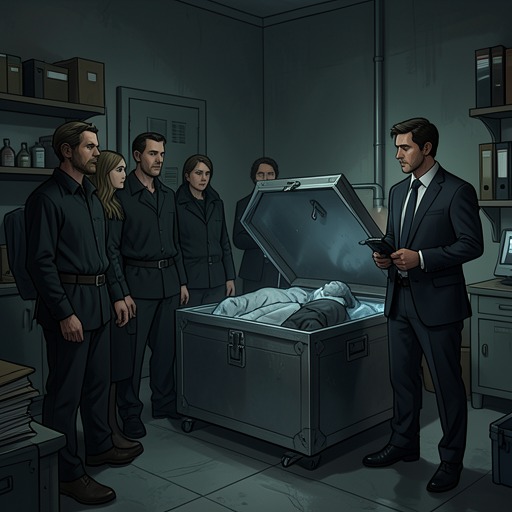
Colonel Flanard
The Vampire Prince’s BrideColonel Flanard is a United Species Corps officer whose intervention first appears to offer rescue but ultimately exposes the Corps as a direct threat to Sara O'Neill and Tom. His decisive significance lies in that reversal: he converts official authority, military force, and access to intelligence into instruments of pursuit, while Sara's actions force the conflict into the open by asserting that she is human and that the people carried in stasis deserve safety rather than exploitation.
Identity and Introduction
Flanard enters the plot through a voice on the comm addressed to Sara with the familiarity of an old superior or colleague. His arrival interrupts the uneasy hospitality offered by Toridge, the pirate captain and Sara's former training companion. When Toridge's crew reports that Flanard is demanding Sara and Tom in exchange for leaving the pirate ship alone, Flanard is already exercising power at a distance: his H-class Clacston gives Toridge's crew no realistic chance of resisting, and his ultimatum turns a personal reunion into a forced transfer.
Once Sara and Tom reach Flanard's ship, he has Tom arrested immediately. The arrest is especially revealing because Sara has expected punishment for her own conduct, yet Flanard initially greets her with apparent warmth, welcoming her back and expressing satisfaction that she is alive and well. His deceptively calm reception contrasts with the detention of her companion and delays the disclosure of his actual purpose. Physically, he is described as Aphrosian, with a slender frame and robin's-egg-colored skin, belonging to a species known for great strength and an uncompromising reputation. Sara had chosen to masquerade as Aphrosian precisely because that identity projected authority and toughness, making Flanard's appearance an embodiment of the institutional persona she had borrowed.
Authority, Intelligence, and Betrayal
Flanard treats Tom according to the official identity in his records: Bond, a man with what he calls a nasty record. Sara rejects that classification and explains that Tom is his real name, while Bond is an operational identity used to conceal his mission. The mission concerns a light-speed ship carrying humans in stasis. Tom was hired by the Ruziers Corporation to retrieve the vessel and return the humans to the core, where they could be awakened, placed in a sanctuary, protected from predatory individuals, and helped through the shock of re-entering a changed civilization.
Flanard's response is not to investigate the humanitarian purpose of the mission or distinguish Tom from the criminal reputation attached to Bond. Instead, he turns the information into leverage. The later confrontation establishes that, after Sara told him about her lover's mission, he contacted the Ruziers Corporation. Once the corporation learned that Tom was actually the son of the warlord Zon, it transferred Tom's retainer to Flanard. This detail changes Flanard's role from concerned commander to interested claimant: he has acquired the financial and institutional position previously held by Tom's employer, then uses that position to pursue the people carrying out the mission.
The betrayal also depends on Flanard's willingness to reduce a complex human and political problem to a security file. Sara insists that the humans in stasis may come from before space travel but could still possess civilization, government, law, culture, and social boundaries. Flanard's records, by contrast, make Bond's reputation the governing fact. The gap between those two perspectives defines their conflict: Sara argues for personhood and sanctuary, while Flanard acts through classification, custody, and command.
Conflict with Sara and Tom
Sara's disclosure that she is human transforms the encounter. She explains that every alien species alive in the present evolved from humans and describes her fear that discovery would result in laboratory confinement. Her demand is not merely for personal protection. She argues that a human sanctuary must be built and that the humans carried in the ship must be allowed to live without constant fear. Flanard is confronted with a subject who refuses the category his system has assigned to her, yet the evidence shows no acceptance of her claim. His authority remains organized around possession and containment rather than recognition.
When Sara realizes that Tom is being held in the brig, she chooses direct action. She takes a petty officer in a chokehold, incapacitates him, removes his weapons, and descends toward the brig to complete a jailbreak. This action places Flanard's command in the role of an obstacle to the sanctuary mission, even though his office and language initially suggest lawful protection. Sara's escape is therefore not a flight from justice in the simple sense; it is resistance to an authority she has concluded cannot be trusted with human lives.
Flanard later finds Sara and Tom again. When Sara identifies herself and greets him with relief, he answers by reminding her that she should not be glad to see him. He tells her that Tom's retainer has been transferred and then declares that Tom's death is necessary. Flanard acknowledges that Sara is a good soldier, but he frames her conduct as proof that she would no longer remain one, whether because she helped a dangerous criminal or because she had crossed the boundaries of the Corps. His language makes discipline a pretext for elimination: loyalty is measured by obedience to the institution, not by the protection of vulnerable people.
Tom responds before Flanard can carry out the threat. He drops his pack, enters the corridor, and fires at Flanard and his men while shielding Sara with his body. Sara fires beneath Tom's arm and helps guide him back toward shelter. Flanard orders them to surrender and insists that they have no chance, but his command fails to end the resistance. The firefight is made more morally complicated by the humans in nearby stasis pods, who are endangered by the exchanged gunfire. Flanard's attempt to capture two people thus places the very population supposedly requiring protection in immediate danger.
Final Confrontation and Narrative Role
Flanard functions as a threshold guardian between the official system and the sanctuary Sara and Tom are trying to create. He controls ships, armed personnel, records, and contractual information, but his institutional resources do not give him ethical authority. The story repeatedly contrasts his power with the fragile bodily acts of resistance that oppose it: Sara seizes a guard, Tom shields Sara, and both continue fighting despite the surrounding pods.
The confrontation ends in a sudden tactical reversal rather than a confirmed victory for Flanard. Sara removes a small round device from her eye socket and sends it spinning down the corridor. She then pulls Tom back and covers his ears as a flash of light and a high-pitched grating sound stop the immediate action. The evidence does not establish Flanard's fate, but it does establish that his demand for surrender has failed and that Sara and Tom retain an escape measure capable of interrupting his assault.
Flanard is consequently defined less by a completed defeat than by the exposure of a system's coercive logic. He begins as a recognizable ally from Sara's military past, appears to offer a formal welcome, and then reveals that he has used her confidence, Tom's classified identity, and the Ruziers Corporation's payment to place both of them under sentence. His role gives the human-sanctuary plot its sharpest institutional antagonist: the danger is not only pirates or openly predatory individuals, but also an official officer who can speak in the language of rescue while pursuing control.